
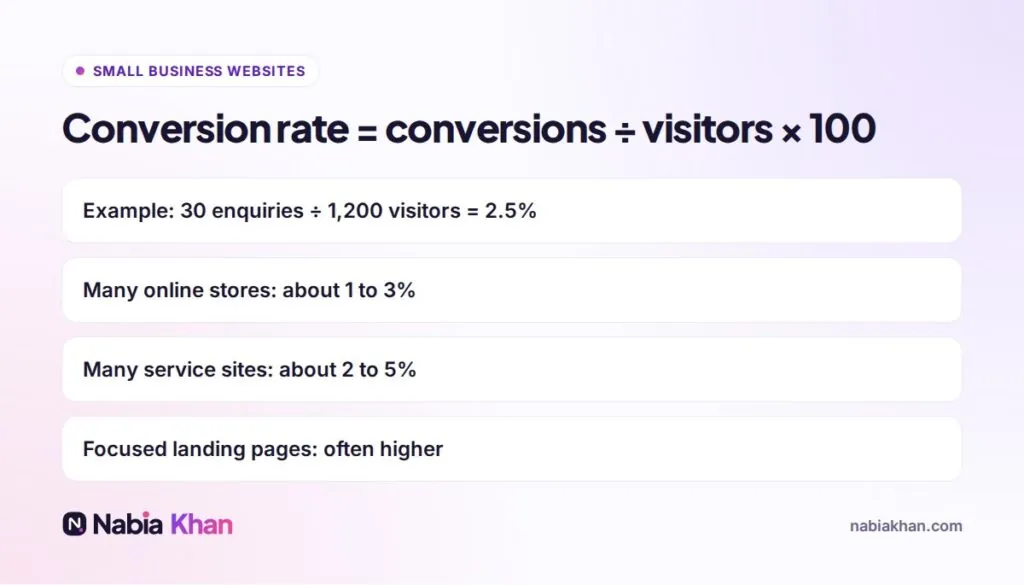
Quick answer: your conversion rate is conversions divided by visitors, times 100. For many small business websites, 2 to 5 percent of visitors becoming leads is healthy, and many online stores convert around 1 to 3 percent. Treat these as rough ranges: your own number improving month after month is what really matters.
“Is my website working?” is one of the questions I hear most. Traffic alone does not answer it. A site with 500 visitors and 25 enquiries is doing better than one with 5,000 visitors and 10. Conversion rate tells you which one you have.
What counts as a conversion?
Whatever moves a visitor towards becoming a customer: a contact form, a quote request, a booking, a phone call from the site, a purchase or a newsletter sign-up. Track the one that matters most to your business as your main conversion.
How to measure it
- Set up conversion tracking in Google Analytics (form submissions, purchases, clicks on your phone number).
- Pick a period, for example the last 30 days.
- Divide conversions by visitors and multiply by 100.
- Write it down and check again next month after making changes.
Why averages can mislead
A high-priced service will convert fewer visitors than a cheap product. Traffic from a Google search for your exact service converts far better than social media traffic. Compare like with like, and look at the conversion rate of each important page, not just the whole site.
The fixes that move conversion rate most
1. A clearer headline
Say what you do, for whom and where. Vague slogans cost conversions.
2. Faster mobile pages
Slow pages lose visitors before they read anything. See WordPress speed optimization.
3. One clear call to action
Decide on the main action and make it the most visible button on every page.
4. Shorter forms
Ask only what you need to reply. Every extra field loses people.
5. Proof near the button
Reviews, ratings and logos of clients right next to the call to action.
6. Show prices or how pricing works
Hiding prices makes many people leave rather than ask.
7. Answer objections
A short FAQ on service pages handles the doubts that stop people from contacting you.
For a deeper diagnosis, read 11 reasons your website is not converting.
Test one change at a time
Change the headline, wait a few weeks, measure. Then the form. Then the proof. Changing everything at once makes it impossible to know what worked.
Want to know where your site is losing people? My free website audit scores design, SEO, content and speed, with practical fixes. If the site needs more than tweaks, see my small business web design service.
Frequently asked questions
What is a good conversion rate for a website?
For many small business websites, 2 to 5 percent of visitors becoming leads is healthy, and online stores often convert around 1 to 3 percent. Your own trend over time matters more than any average.
How do I calculate my website conversion rate?
Divide the number of conversions (enquiries, bookings or sales) by the number of visitors in the same period, then multiply by 100.
Why is my website conversion rate low?
Common causes are unclear headlines, slow mobile pages, hidden prices or contact details, long forms, weak proof and traffic that does not match what you sell.